Anton Maliauski Anton Maliauski

Series / Just write

This is a series sorted in chronological order.

When I sit down, turn on the computer and force myself to write even a couple of lines, I become a cliché machine.

It’s funny that sometimes I myself get high on insight, clarity of thought and beauty of style.

So what’s the deal?

You need to write when you want to write something. My advice is to use a regular notepad or start each day with a new note. One note for everything. You can create such a note every day or week, or you can even write it in one large text file ([OBTF](https://mikegrindle .com/posts/obtf)).

Write, rewrite, delete, write again. This practice is beneficial in itself. You don’t write for the sake of good text now – text is just a tool. You write to focus on your thoughts.

Final editing on the one hand is useful because… helps to structure thoughts, on the other hand, when editing we lose the whole “broth”. It is necessary to look at texts not only as the delivery of value in the form of clear and crystallized thoughts, but as a space in which the reader is born his own.

Where else is there such space in media? Podcasting is the closest thing to this because it creates a space in which you and the listener spend time thinking. It won’t work with video (or it’s very difficult) because… the authors still need to fight every second for the viewer’s attention.

February 23, 2024

I’ve checked this many times. If something comes to mind, write it down right now. Then it will be a different you with different thoughts and energy. And to force yourself means to no longer be real.

This is how Pyotr Rukavina maintains his blog:

I generally write in real time: an idea occurs to me, and the idea takes on a life of its own, gets “called to be written about,” and I try to carve out the time to do so right away. I don’t find the process of writing onerous; generally words flow out of me, and while I will go back and edit the words, finessing the meaning, correcting errors, what emerges is generally fairly close to what I wrote down in the first place.

I write a lot of posts via email, a capability that has allowed me to take my writing out of “sitting in front of a laptop” and, really, anywhere I’m struck. Writing on a tiny iPhone SE isn’t the best and most natural environment (though voice-to-text helps), but the benefit of being able to “strike while the iron is hot” outweighs the fussiness of the tool. These days perhaps half of what I write is on the phone.

February 26, 2024

Notes help to record emotions and feelings of the moment. In the future, it will be much easier for me to dig up a note to remind myself and others of that very moment.

Even if only for yourself. Of course, I don’t think that the reader will immediately shed tears after reading my quote from an article from a year ago. No! First of all, I want to make myself cry or laugh. This old note becomes part of a new product (note, article, book, podcast, film) and brings a piece of that energy here. This can be compared to the torch that I brought to light a new fire.

I thought asking myself questions would help me write, but it turns out they hinder me. The frameworks we put ourselves in were not invented by us and not specifically for us. Yes, we are all Homo sapiens1 — we can be classified and have instructions written for us. But instructions on how to do morning exercises or count in a column are one thing, and how to think and create is another — we have different intellectual abilities, interests, and our moods often change. There are many variables, and the best rule that will work is no rules (frameworks). Write.

October 5, 2024
Favourite

I remember the good times of LiveJournal and autonomous blogs1. I met people without saying “hello” to them. I read their thoughts, encountered oddities and stupidities that gradually revealed the author’s personality. They were my friends!

Then came marketing. Marketers taught how to write better - this was the beginning of the end. Blogs became like plastic “Barbie houses”. There is no need to be afraid that artificial intelligence will replace writers, because the writer has already been replaced by a marketer.

Instead of creating a place to express (or find) themselves, authors turn their blog into a glamour magazine, “business media”, or a verified dry document. They try to find a better voice and correct mistakes, but in the end they lose both their voice and the opportunity to make mistakes (because we must make mistakes in order to grow).

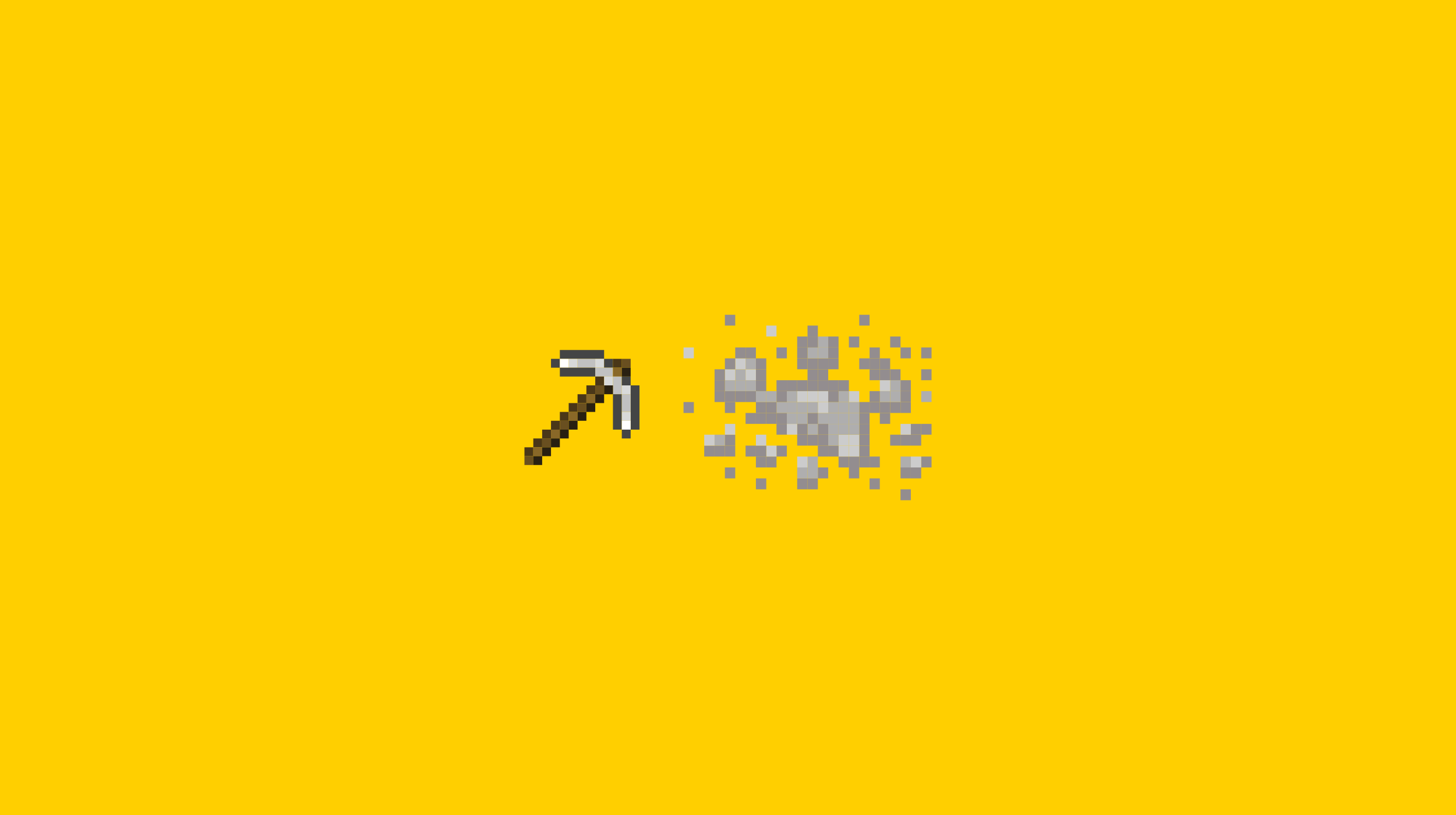
Notes are not a work of art - they are ore.

Figure: image of a pickaxe and ore on a yellow background

Yes, you need to learn to write well — good text helps to structure thoughts. But the “editor-in-chief”2 cutting up the text in pursuit of points is extreme. Read the “editorial”3 texts — dry, documentary, with an artificial note of soul.

I was surprised to notice that I find it interesting to reread the drafts of my notes (notes that I did not publish for some reason). This is ore — black, dirty, but with value inside. Or without value, but this remains to be seen. There are real emotions there, because they are still very fresh; thoughts that lead to a dead end or to the top of the mountain.

“Ore” is needed for production. News, thoughts, links. For example, I’m working on a podcast right now and have to process a lot of that ore. Of course, you can rebroadcast it as is, but then I won’t be in it. I want to be a source, not a channel - that’s very important!

To have the courage to publish a draft as soon as possible, you need to work with the garage door open.

Here’s what Andy Matuschak4 writes about public work:

There’s a scientific glassblowing studio north of us; I walk past it on the sidewalk often. By simply existing, and having a nice sign that faces the street, they are doing a small public service every day. We are here, working.

In the same light industrial complex as the Murray Street Media Lab, there’s a woodworking shop, and the man who runs it always keeps his door propped open. Simple as that. What a delight, every damn day, to ride my bike past that door and peek inside and see all his tools, the boards stacked up for whatever commission he’s undertaking. I am here, working.

For me, Andy’s evergreen notes is a great example of public service.

I don’t know where my thoughts will take me. I just create a new text file in Obsidian and start writing - whole thoughts or fragments, links and feelings can go in there. Tomorrow, I or someone else will find a gem in this ore. Or not.

February 15, 2026

I had often heard about this, but I could never truly grasp the idea myself. I’m talking about the fact that notes, in any format or medium, are first and foremost for ourselves.

Earlier, inspired by Luhmann, Matuschak, and others, I wrote notes because “that’s what you’re supposed to do.” I had heard they worked, that “evergreen” notes should produce some kind of effect in the future. I believed it, but I didn’t really understand what it meant for a note to “work.” Of course, I enjoyed writing, and that gave me energy to continue, but from time to time I would find myself facing a concrete wall with a large inscription: “WHY?”

I want to understand why dictating text works not only as a speed boost, but as a different mode of thinking.

I used to talk about fast capture, but it’s not just about speed. In an interview, Andy Matuschak mentioned that he walks around the room and dictates text instead of typing. What caught my attention wasn’t that it’s faster, but that speaking seems to switch off the inner editor. When you type, you’re constantly tweaking, deleting, rewriting, and that can look like thinking. But sometimes it’s more like a brake.

I’m trying to write notes using voice input.

I’m seeing it more clearly: capturing thoughts matters more than trying to make everything perfect from the start. Yes, editing and polishing improve the text, and the thoughts become cleaner and more crystallized. But fast capture matters for something else: it lets me remember later what I was even thinking about.

On walks, I used to record thoughts on a voice recorder and then transcribe them into a huge “wall of text”, sometimes even with timestamps. But it turned out to be inefficient: there’s too much text, and I don’t want to return to it. Publishing it feels even less appealing. Speech and text simply follow different rules.

Today there are tools that can quickly turn a voice note into clear, formatted text. I’m talking about artificial intelligence. And it’s important to clarify: in this mode, it’s not about “write it for me”, it’s about capture.

The point is that you need to capture not only the thought, but also the feeling. Without that, the text becomes cold and empty. If I come back to it in six months, it won’t hook me in any way. Intonation, voice, emotions, and stories are exactly what create the hook.

So my task, when I make notes like this, is simple: give the AI tool a command like “don’t rewrite”, don’t sterilize it, keep the human texture. Let the text remain mine, just a bit clearer.

This is my attempt to find a place for the machine in life: neither to push it away nor to hand it everything, but to use it as the right tool. Because I can spend an hour writing this same text, or I can capture it in a minute or two and move on. Especially when a thought arrives during a walk and it matters to save it immediately, together with the state.

There’s one more idea: if a note is “evergreen” and I want to keep working on it, I can (and should) update it. Read it quickly, bring it back into the chat, continue the dialogue, sharpen the wording, look at it from new angles, and the thought becomes alive and “evergreen”, not a one-time capture.

And the key focus here is this: the priority of my own speech and capturing thoughts without later “re-melting” them into something else. Yes, I have another mode where I work as a “text architect”, and AI helps me assemble and connect blocks faster. But in notes like these, what matters to me is capturing the state.

Sometimes it’s easier for me to capture the flow first than to construct a thought from scratch. We’re all different: for some it’s easier to write, for others it’s easier to talk to silence. I’m just looking for the best way to express my real self here and now.
« Earlier
Later »