
Feed Me Batteries
A typical battery collection container almost always looks like a technical necessity. It communicates its function, but it doesn’t attract attention. It can be placed in a store, accompanied by instructions and an environmental message, but the interaction itself still feels dull and impersonal. I wanted to turn an unnoticed, obligatory object into something people would want to approach.
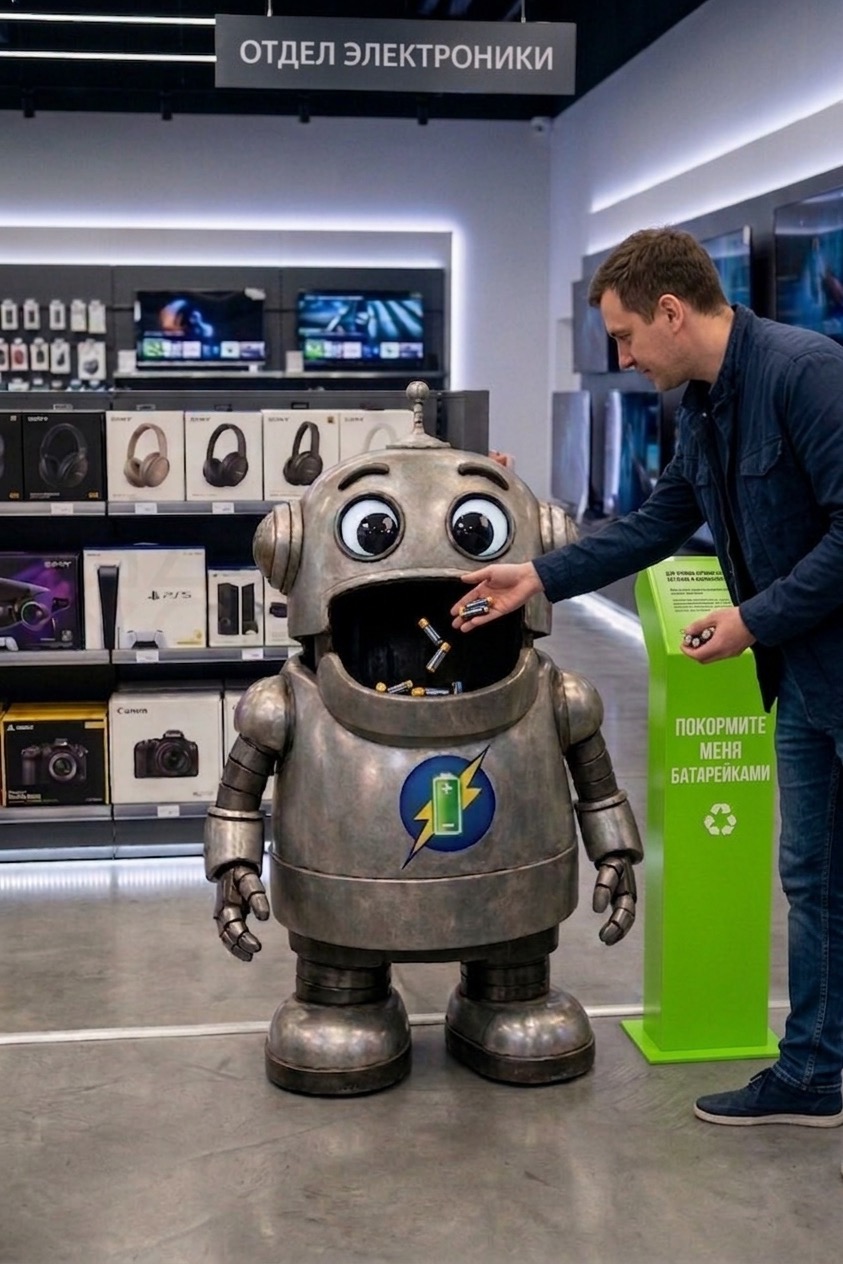
The idea didn’t start with form, but with a shift in the action itself. Not “dispose” or “recycle,” but “feed.” A single verb changes the entire scenario. A person is no longer just getting rid of used batteries, but entering into a kind of interaction with the object. That’s how the robot with an open mouth appeared, waiting to be fed.
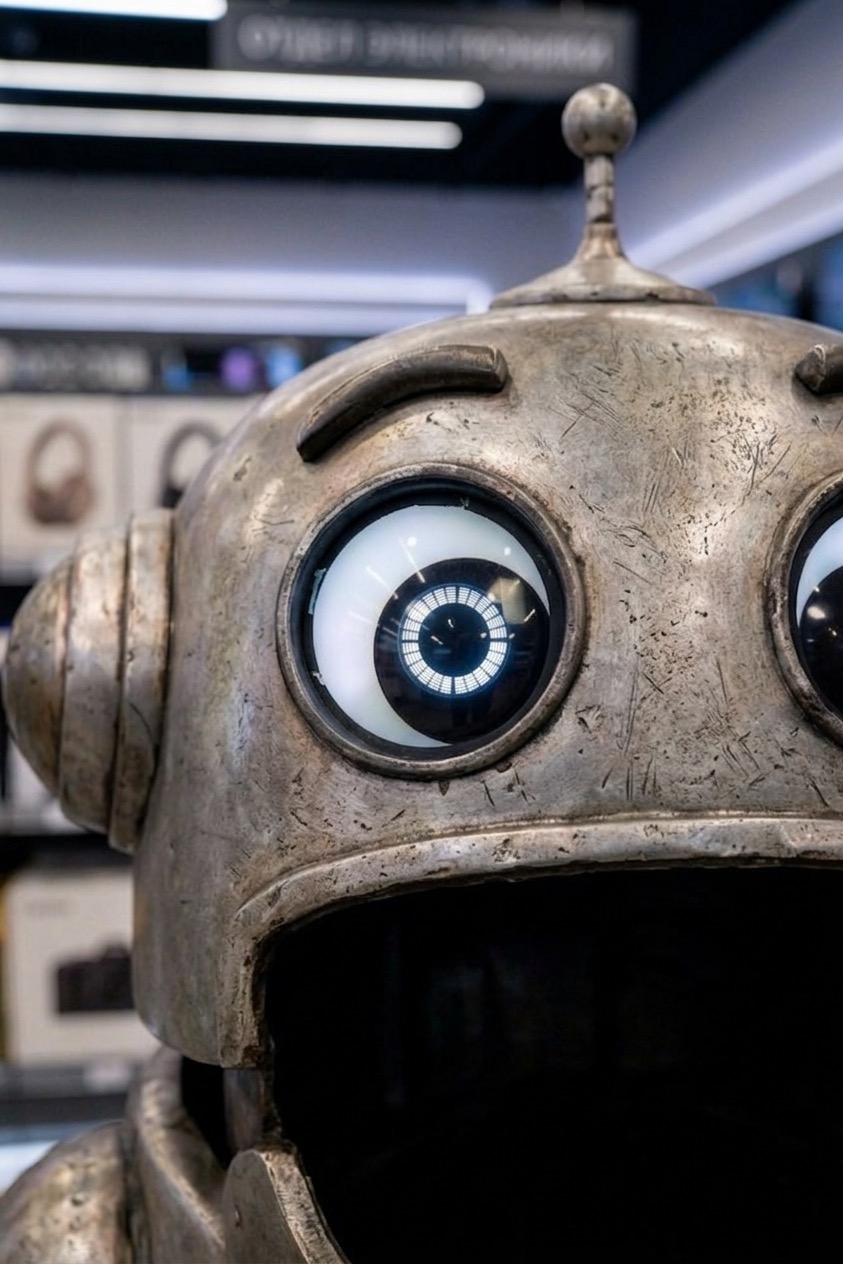
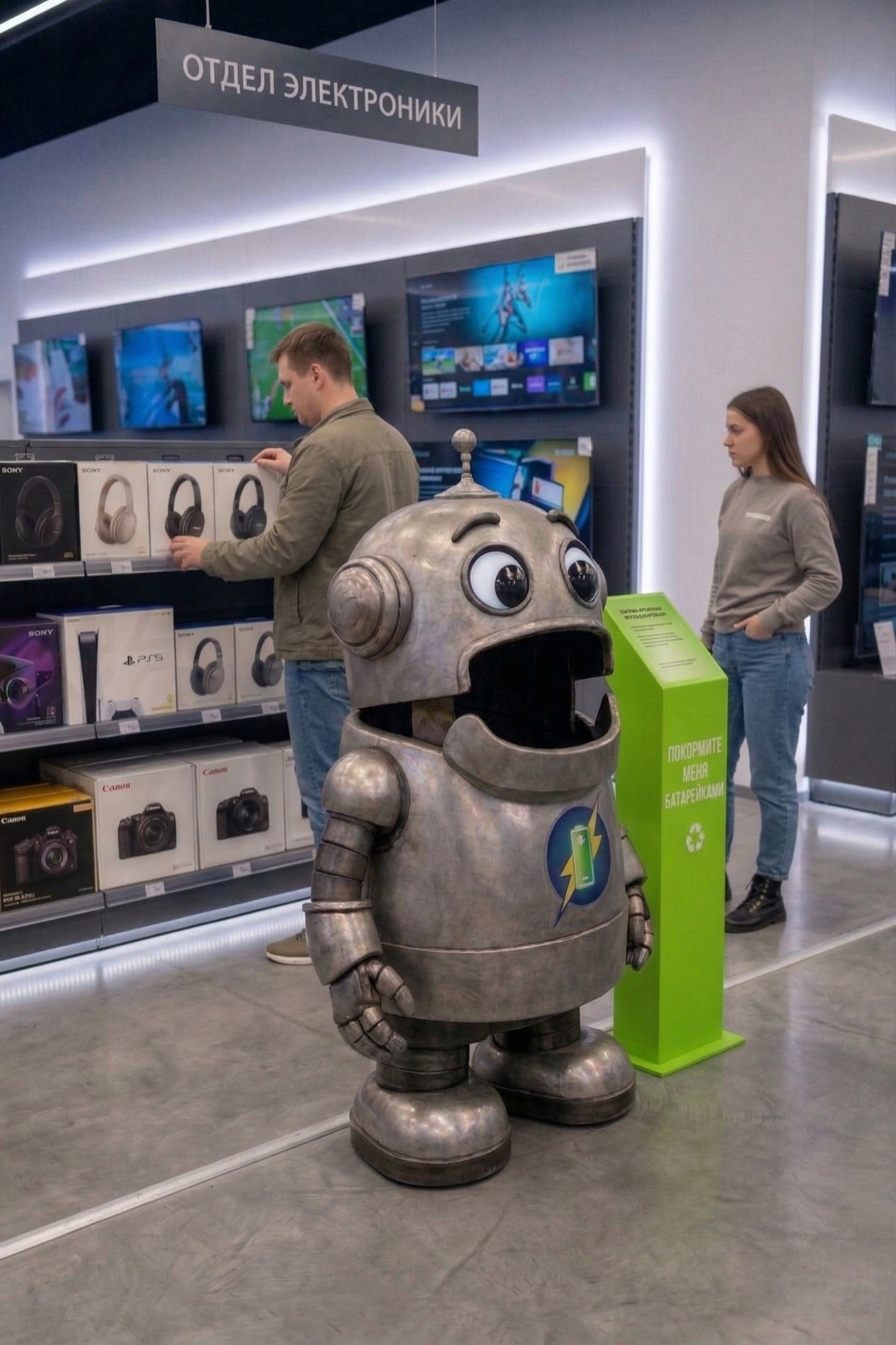
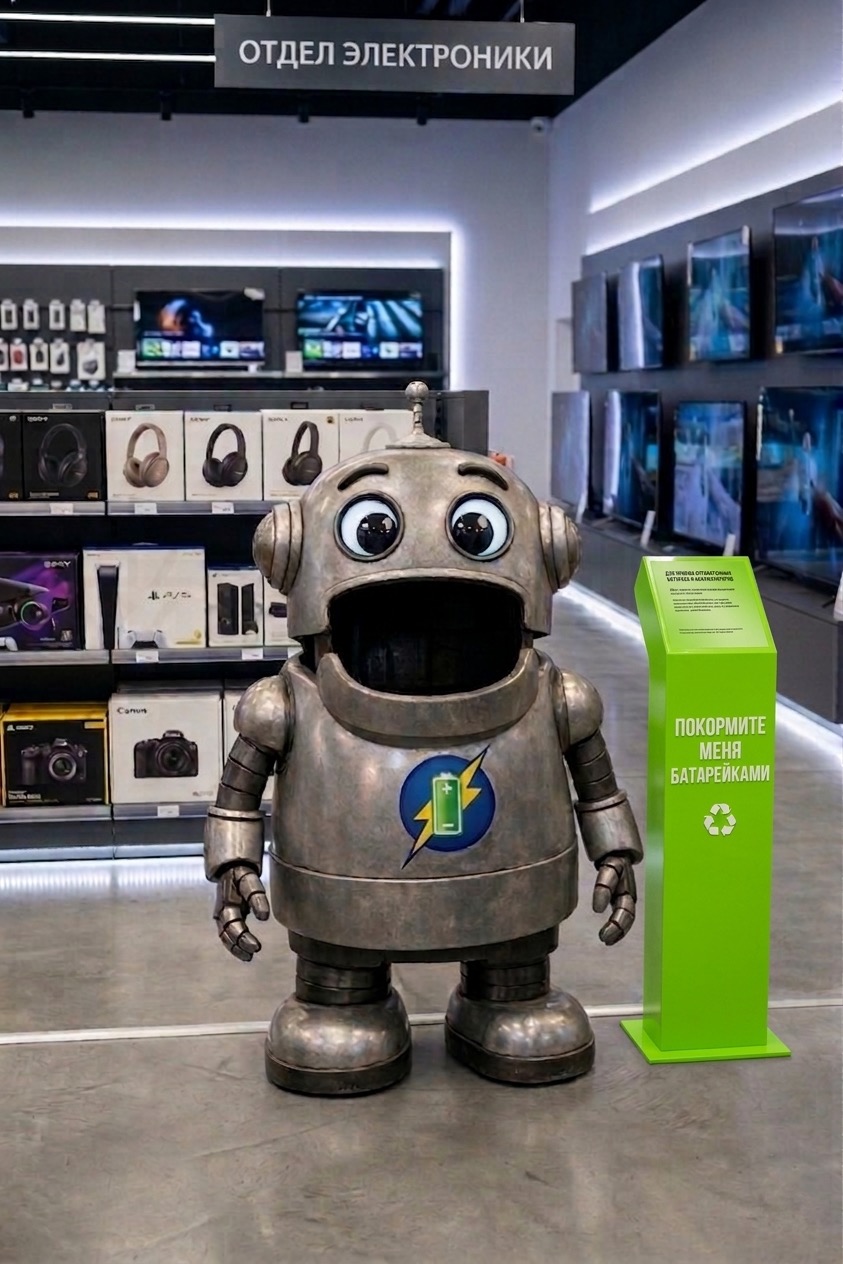
It was important that this robot didn’t look like just another futuristic terminal. That’s why it feels slightly brass-like, a bit worn, as if from an earlier era of robots. Not glossy, not sterile or ultra-modern, but full of character. Because of that, it moves from the category of “technology” into the category of “character.” It doesn’t intimidate, doesn’t feel like a system, and doesn’t look like an imposed service. It feels as if it has been standing in this store for a long time and has already become part of the place.
The open mouth matters too. It is not just a collection slot, but a gesture of waiting. The robot is not only performing a function, it also seems to be addressing the person. There is a very simple psychology in that: it is waiting, which means its waiting can be answered. Because of that, the action stops being a dry obligation and turns into a small ritual that stays in memory. Next time, a person remembers not the container in the corner, but the robot itself: “I haven’t fed him in a while.”
It is also important how the communication is structured here. It is divided into two layers. The first works from a distance: the robot itself, its posture, the phrase “Feed Me Batteries,” the green stand, and the recycling symbol. Even before reading the instructions, the object is already perceived as something connected to ecology and proper disposal. At the same time, it does not begin by speaking in an official tone. It first catches attention, offers a gesture, creates interest. The second layer works up close: the upper part of the stand with clear information that this is specifically for collecting used batteries and rechargeable batteries. First, the person is drawn in through the image, the color, and the character of the object, and only then receives the full explanation. That order was important to me: not to overload someone with instructions from the very first seconds, but to first invite them into the situation.
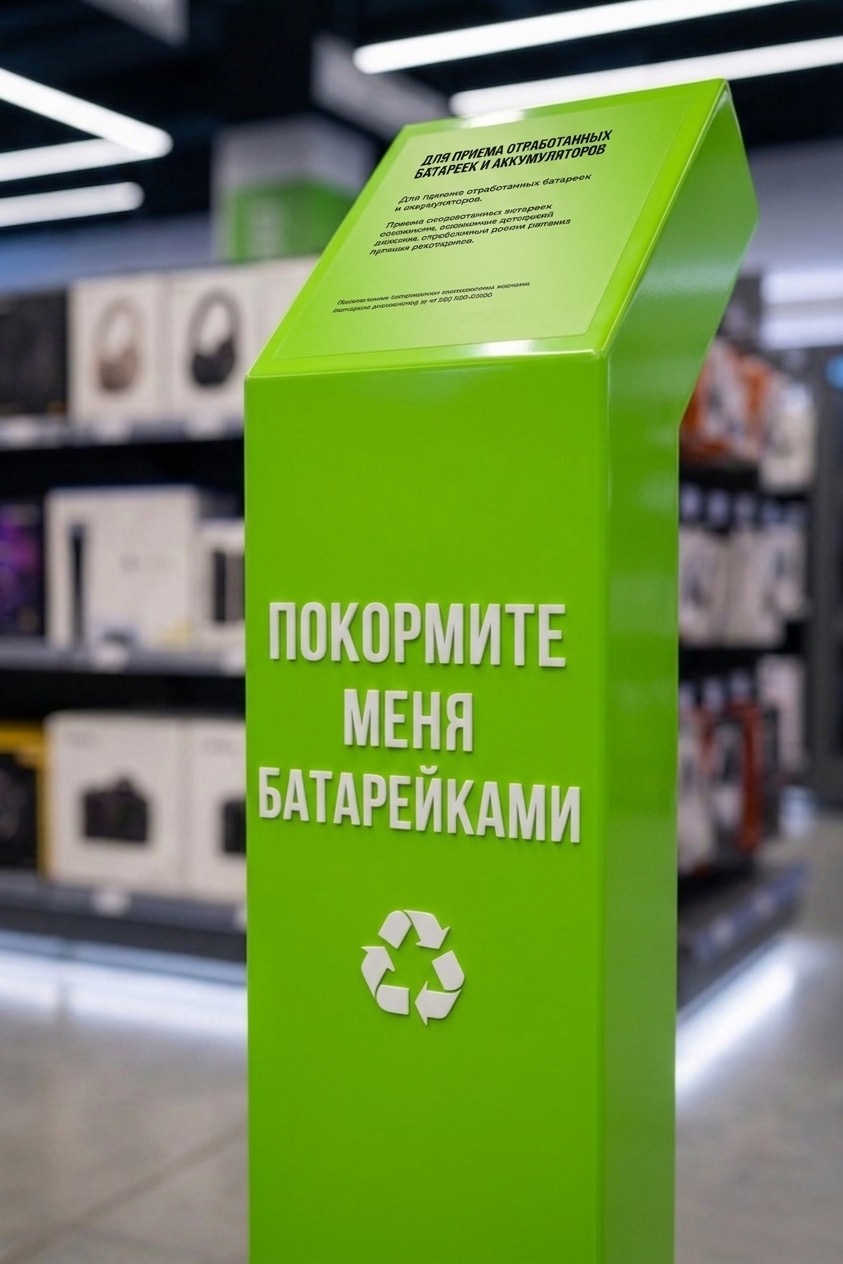
Because of that, an element of play appears in the object. And that is exactly what makes the whole scene feel alive. To walk up, lean in, and feed the robot batteries is no longer the same as simply dropping them into a dull box. A child reads this action especially naturally: for them, it is literally a game they want to join. But it works not only for children. An adult responds to this gesture too, just differently. They may smile, pause for a second, notice the character of the object, but still enter the same scenario. That, to me, is the value of the solution: the playfulness does not make the object childish, it makes a simple action human and memorable.
The robot can be strengthened with one more almost invisible detail: it can slightly turn its head and shift its gaze, as if noticing the people around it. Not like an attraction and not as a demonstration of technology, but as one more sign of presence. In that moment, it feels not like a device, but like someone who is here and waiting.
For me, this project is not about decorating an ordinary bin and not about “creativity for creativity’s sake.” It is about how, in a real space, the character of interaction with the simplest function can be changed. Instead of a square, unremarkable box, an object appears that people notice, remember, and want to return to. Instead of an impersonal action, a gesture appears. Instead of a dry instruction, a small scene in the store emerges.
I work not only with visual form, but also with interaction scenarios. For me, design starts not with styling, but with understanding the context: how a person behaves in a space, what they notice, how they make a decision, and what they remember after coming into contact with an object.
These kinds of tasks lie at the intersection of strategic thinking, research, and visual communication. Here, graphic design does not exist separately, but becomes part of a broader work with behavior, attention, and meaning. If you need a project that not only looks convincing but actually changes the way a person interacts with an object or an environment, I am open to collaboration.