Anton Maliauski Anton Maliauski

Blog

RSS

In archive all notes in a list, sorted chronologically


June 8, 2026

I am sitting under a tree.

It has sheltered me beneath its huge canopy. I cannot see the structure of the leaves, cannot see whether there are flowers there or not. It is just a large dark roof above me.

In front of me is the Svislach. The embankment, concrete, rare passersby. Night, silence, darkness. I am a little bored.

During the day, it feels as if we have many options. Any photographer will understand me. And not even necessarily a professional photographer, but a person who goes out with a camera, or a person who goes out without a camera but simply knows how to look. During the day, you dive into this abundance. You see so much. The world itself offers you frames, shapes, light, faces, trees, reflections.

But sometimes you do not want to choose from what is already given. Sometimes you want to look into the unknown. To trust what is here now. To see what is around me within arm’s reach. To touch it, in another language.

I take out the camera. Maybe out of boredom. Maybe with a childlike curiosity. I point it upward, turn on the flash, and take one shot.

Not ten. Not a series. I do not check the screen.

Just one shot.

I see the flash light up the tree for a second. And the world immediately returns back into darkness. I put the camera away and continue walking through the night city.

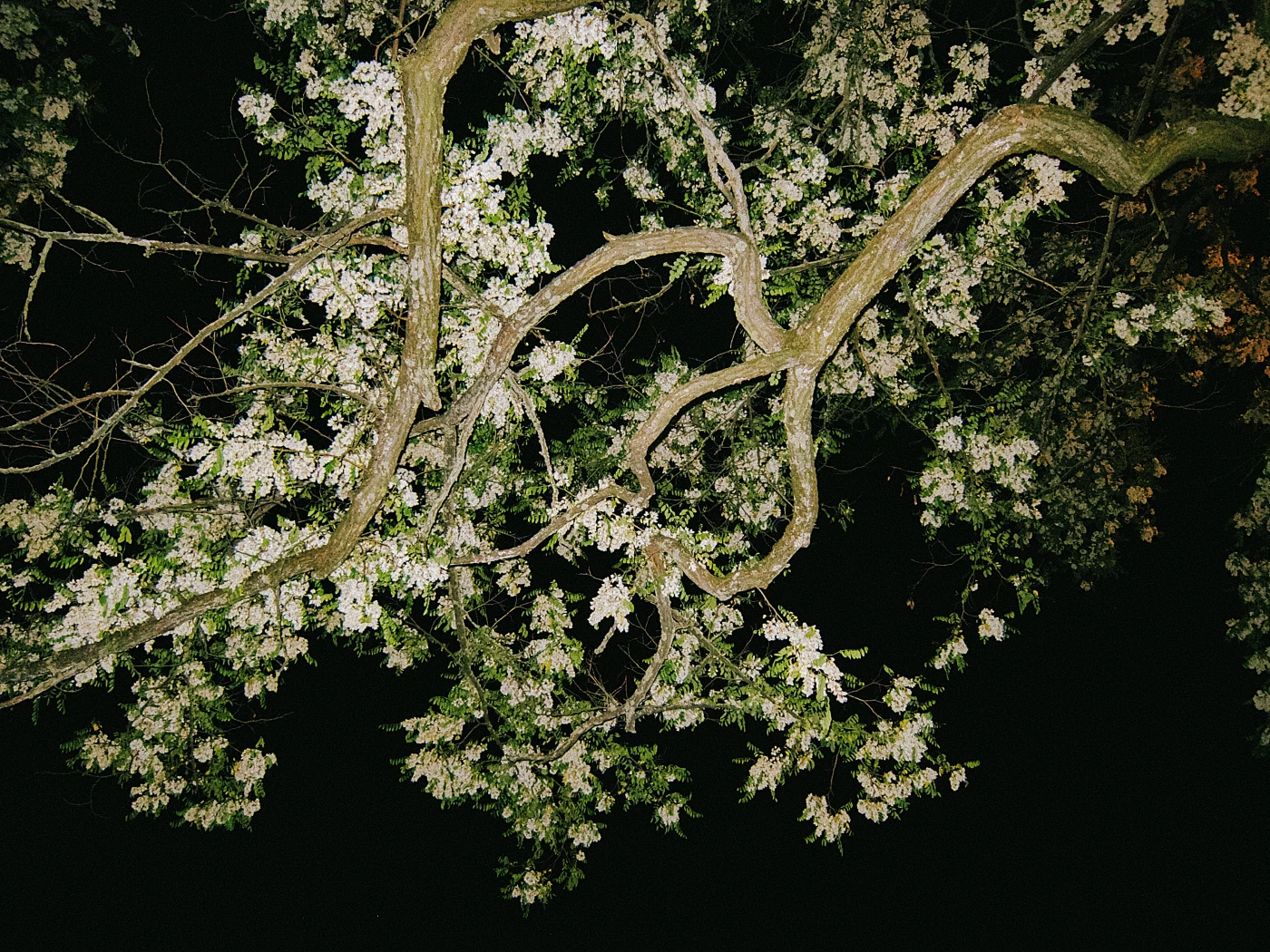
But later, already at home, when I open this photograph on the computer and develop it, I suddenly see what I did not see there, on the bench. Leaves. Flowers. Structure. The beauty that, at that moment, was right beside me, above me, around me.

Flowering tree branches against the night sky.
I saw all this beauty only after the photograph was developed.

I made a simple accidental “shot” with the camera, but it illuminated what was already there in reality.

In the note “A View from the Dark”, there was the thought that sometimes you need to remove the excess light in order to see differently. To look from the dark. To listen from silence. To step out of the noise of the day, out of the obvious, out of ready-made illumination.

Here the thought is similar, but it is about something slightly different.

Here I am not simply looking from the dark. I am trusting the space. Trusting the moment. Taking a step without knowing what exactly I will see.

Perhaps this is how it happens in life too.

We make some simple step. Sometimes almost accidental. We direct our attention toward a place where there seems to be nothing special. We illuminate a piece of reality for a second. And in that very moment, it may tell us nothing. We see only the flash, a brief illumination, an instant. And then everything returns to darkness again.

But something has already happened.

We have already exposed reality.

And now we only need to stop and see what has emerged.

June 1, 2026

It’s interesting how photography makes you notice things that help you look at other areas of life as well. And perhaps it’s not only photography that works this way. Any practice you truly focus on can reveal something larger. Not only inside the practice itself, but around it too.

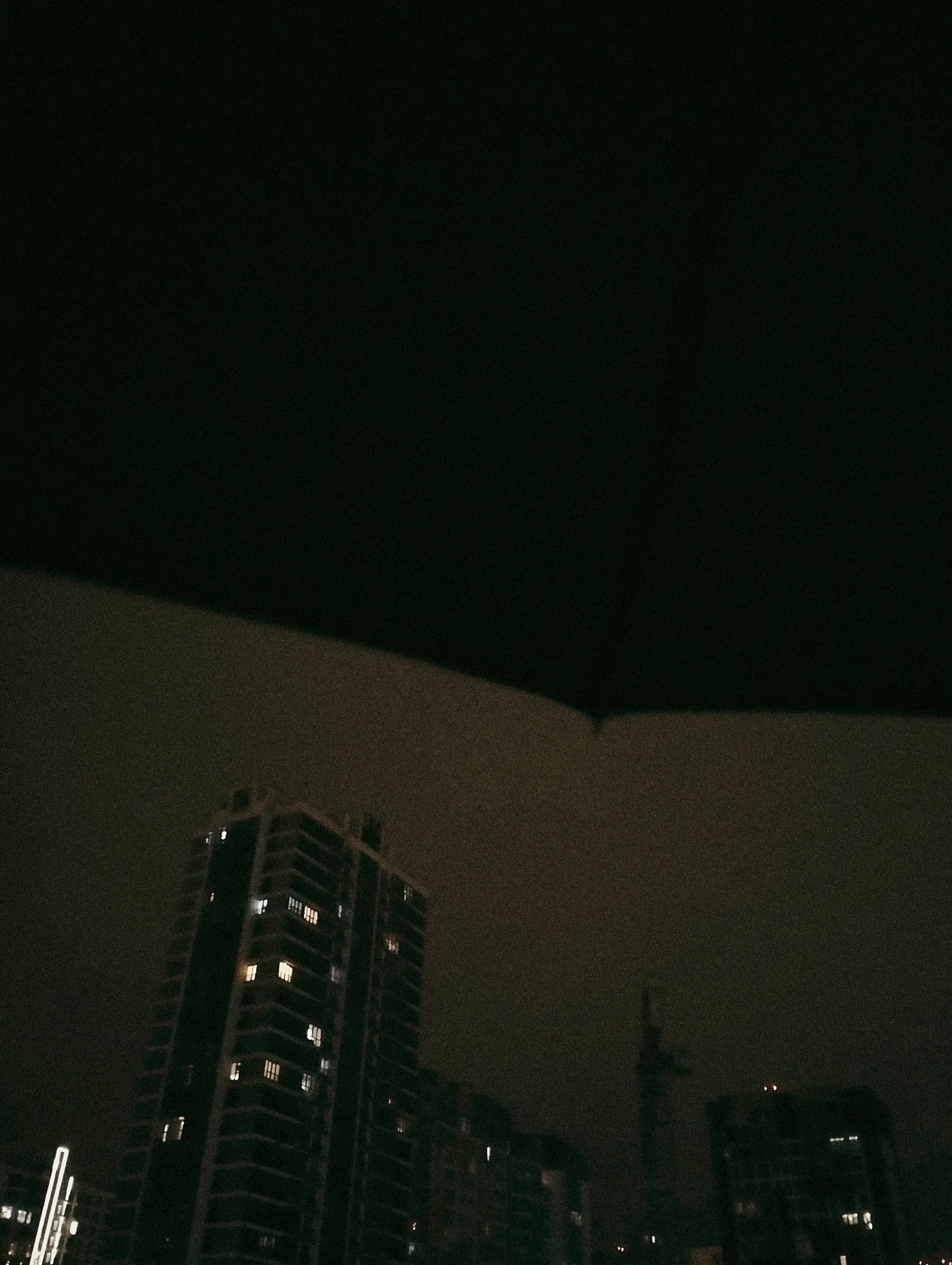
I’m thinking now about dark photography. About an image where the details are almost indistinguishable. Where the play of light and shadow is not so obvious. Where there are no strong jumps in brightness, no familiar contrast, no immediately readable picture. And this photograph is not necessarily made this way on purpose. Sometimes it is simply an image in a dark key. A photograph taken at night.

Night cityscape with high-rise buildings and an umbrella in the foreground. Dark sky, visible lights.

At night, our attention works differently. We look at light differently. We become more sensitive to faint details, to barely visible transitions, to small patches of brightness. We do not need as much light as we do during the day to make out form, shadow, presence.

But the most interesting thing does not happen when you look at such a photograph at night. The most interesting thing begins during the day. You open the image in daylight, and suddenly there is just a dark rectangle in front of you. What was full of details at night becomes empty during the day. Not because the details are not there, but because you are no longer looking from the same state.

And if we look at this more broadly, something similar happens in life. We can also fail to see certain moments because we are looking at them from the wrong state. Not in the right light. Not in the right inner time. What was once full of meaning can later seem like just a dark spot. We look and do not understand what was there. We do not make out the details. We do not feel the depth. We pass by something that was once alive.

To see such a photograph, you almost have to return to the state in which it was made. To look at it in a different light. At a different time of day. And if we are speaking about life, in a different mood, in a different silence, with a different kind of attention.

Sometimes, to see something, you do not need to add more brightness. Sometimes you simply need to enter the darkness again.

I’m realizing more and more how alien LinkedIn feels to me.

Not just uninteresting. Not just inconvenient. Alien in its very structure. It is a space of corporate busyness, robotic politeness, and constant self-packaging. There, a person seems to turn themselves in advance into a job description, a career signal, a neat professional silhouette.

And at some point I realized: I don’t want to be there even formally.

A good professional is not made of competencies alone. They are made of taste, character, attentiveness, experience, strangeness, pain, curiosity, mistakes, pauses, inner fire.

And LinkedIn seems to say:

“No, no. Leave only the title, the case study, the achievement, the team thank-you, and five bullet points about leadership.”

Not a person. A profile.

P.S. Symbolic how it turned out: May 1.

From series Just write
  1. Just help me capture this right now

I’m trying to write notes using voice input.

I’m seeing it more clearly: capturing thoughts matters more than trying to make everything perfect from the start. Yes, editing and polishing improve the text, and the thoughts become cleaner and more crystallized. But fast capture matters for something else: it lets me remember later what I was even thinking about.

On walks, I used to record thoughts on a voice recorder and then transcribe them into a huge “wall of text”, sometimes even with timestamps. But it turned out to be inefficient: there’s too much text, and I don’t want to return to it. Publishing it feels even less appealing. Speech and text simply follow different rules.

Today there are tools that can quickly turn a voice note into clear, formatted text. I’m talking about artificial intelligence. And it’s important to clarify: in this mode, it’s not about “write it for me”, it’s about capture.

The point is that you need to capture not only the thought, but also the feeling. Without that, the text becomes cold and empty. If I come back to it in six months, it won’t hook me in any way. Intonation, voice, emotions, and stories are exactly what create the hook.

So my task, when I make notes like this, is simple: give the AI tool a command like “don’t rewrite”, don’t sterilize it, keep the human texture. Let the text remain mine, just a bit clearer.

This is my attempt to find a place for the machine in life: neither to push it away nor to hand it everything, but to use it as the right tool. Because I can spend an hour writing this same text, or I can capture it in a minute or two and move on. Especially when a thought arrives during a walk and it matters to save it immediately, together with the state.

There’s one more idea: if a note is “evergreen” and I want to keep working on it, I can (and should) update it. Read it quickly, bring it back into the chat, continue the dialogue, sharpen the wording, look at it from new angles, and the thought becomes alive and “evergreen”, not a one-time capture.

And the key focus here is this: the priority of my own speech and capturing thoughts without later “re-melting” them into something else. Yes, I have another mode where I work as a “text architect”, and AI helps me assemble and connect blocks faster. But in notes like these, what matters to me is capturing the state.

Sometimes it’s easier for me to capture the flow first than to construct a thought from scratch. We’re all different: for some it’s easier to write, for others it’s easier to talk to silence. I’m just looking for the best way to express my real self here and now.

I’ve started rereading Rework (the English edition is titled Rework: Change the Way You Work Forever), and the first chapter is called “Ignore the Real World.”

I realized how my attitude toward these kinds of bold concepts has changed:

  1. Yes, great! Do whatever you want! They don’t know anything and don’t understand!
  2. But the world became what we see now, so the rules of the game clearly work. A norm is a viable order.
  3. (you are here) Sometimes play helps you get unstuck and change something (at least your point of view, to start with).

Now I look at it positively. Maybe I’ve simply come to see that rules and norms allow for mistakes. That doesn’t mean the mistaken thing will take root (probably not). But as a designer, I understand that experiments and play are necessary.

That’s what design thinking is. Not the version with sticky notes on a wall, but the one about understanding the balance between norms and errors.

From series Just write
  1. Turn off your inner editor

I want to understand why dictating text works not only as a speed boost, but as a different mode of thinking.

I used to talk about fast capture, but it’s not just about speed. In an interview, Andy Matuschak mentioned that he walks around the room and dictates text instead of typing. What caught my attention wasn’t that it’s faster, but that speaking seems to switch off the inner editor. When you type, you’re constantly tweaking, deleting, rewriting, and that can look like thinking. But sometimes it’s more like a brake.

February 15, 2026
From series Just write
  1. Notes in the Margins

I had often heard about this, but I could never truly grasp the idea myself. I’m talking about the fact that notes, in any format or medium, are first and foremost for ourselves.

Earlier, inspired by Luhmann, Matuschak, and others, I wrote notes because “that’s what you’re supposed to do.” I had heard they worked, that “evergreen” notes should produce some kind of effect in the future. I believed it, but I didn’t really understand what it meant for a note to “work.” Of course, I enjoyed writing, and that gave me energy to continue, but from time to time I would find myself facing a concrete wall with a large inscription: “WHY?”

October 31, 2025
Favourite
From series Like or Love
  1. The soul is the system’s glitch

No psychologist today will tell you about the importance of a kindred soul, or how to find it. They themselves live in a perverted world and present it as the norm.

The soul is not a function of the system — it’s a glitch, a void, a call, a light. It’s something that should not exist in a functioning system.

Recently I already wrote about the lighting that pretends. I had a feeling they’d outdo themselves. And just the other day, I was “lucky” (and there’s really no other word for it) to ride yet another version — or configuration — of this miracle of engineering and design thinking. Are you ready? They’ve added a red LED strip along the windows. Cool, right? Innovation!

But that’s not all.

A photo of a red LED strip under the window in the trolleybus
Now there’s a red strip too!

Huh? What do you think of this design? I even had to squint from how bright the interior was.

Trolleybus interior: bright red seats with the “MAZ” logo

Now, seriously.

When there’s no taste, everything slowly turns into a Christmas tree. Unfortunately, that’s the case here now.

Grandmother and grandson
Minsk, 2023-07-26

I love capturing simple moments. Different generations. Ordinary people living ordinary lives. Without pretense or gloss. That evening I wasn’t thinking about the value of the frame. I just met people and pressed the shutter button.

It’s these kinds of shots that teach you to appreciate the moment. I open the photograph I took that summer evening and think about them. Some are gone. Someone got distracted by something trivial. Someone is going through a crisis or walking into the fog toward a dream, feeling the brass of life and unaware of the coming storms and cliffs.

It’s not about another lucky “shot” for social media. It’s about attention. Despite the noise and the world’s overindulgence, to notice something simple and alive.

« Earlier
Later »